[Télécharger] Chemical Processes in Wastewater Treatment de W.John Eilbeck,Gerry Mattock PDF Ebook En Ligne
Télécharger Chemical Processes in Wastewater Treatment de W.John Eilbeck,Gerry Mattock Francais PDF
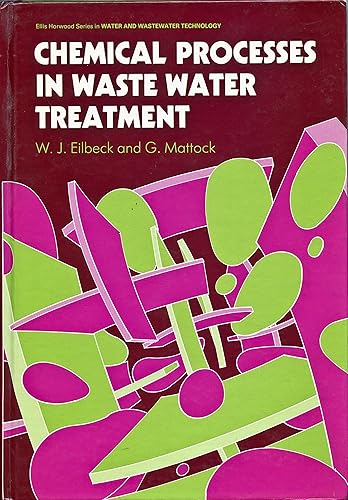
Télécharger "Chemical Processes in Wastewater Treatment" de W.John Eilbeck,Gerry Mattock Livres En Ligne
Auteur : W.John Eilbeck,Gerry Mattock
Catégorie : Livres anglais et étrangers,Professional & Technical,Engineering
Broché : * pages
Éditeur : *
Langue : Français, Anglais
Télécharger Chemical Processes in Wastewater Treatment de W.John Eilbeck,Gerry Mattock Livre eBook France
(PDF) Biological and Chemical Wastewater Treatment Processes ~ This chapter elucidates the technologies of biological and chemical wastewater treatment processes. The presented biological wastewater treatment processes include: (1) bioremediation of .
(PDF) Wastewater Treatment: Biological and Chemical Processes ~ PDF / On Jan 1, 2002, Mogens Henze published Wastewater Treatment: Biological and Chemical Processes / Find, read and cite all the research you need on ResearchGate
Water and wastewater treatment: chemical processes ~ It then presents some important considerations and design guidelines for chemical unit operations used in water and wastewater treatment processes. The chapter also briefly discusses the challenges associated with environmental risk assessment for contaminants of emerging interest (e.g. PPCPs), the prioritization of contaminants and the definition of new treatment performance criteria for .
Basic Principles of Wastewater Treatment ~ No physical-chemical wastew-ater treatment processes are covered, although some physical operations, such as sedimentation and aeration, are dealt with since they are an integral part of some biological treatment processes. The books’ proposal is to present in a balanced way theory and practice of wastewater treatment, so that a conscious selection, design and operation of the wastewater .
Chemistry of Wastewater - EOLSS ~ and treatment. 1. Introduction Wastewater is the liquid end-product, or by-product, of municipal, agricultural, and industrial activity. As such, the chemical composition of wastewater naturally reflects the origin from which it came. In fact, the chemistry of wastewater reflects to a very high degree the chemistry of life. Just as wastewater chemistry reflects chemistry of human activities in .
(PDF) Review on Waste Water Treatment Technologies ~ Wastewater treatment is the set of measures and processes by which the chemical or bacteriological impurities contained in the wastewater are reduced below certain limits so that these waters do .
Biological and Chemical Wastewater Treatment Processes ~ Chemical treatment is now considered as a tertiary treatment that can be more broadly defined as “treatment of wastewater by a process involving chemical treatment”. The mostly implemented chemical treatment processes are: chemical precipitation, neutralization, adsorption, disinfection (chlorine, ozone, ultraviolet light), and ion exchange.
BIOLOGICAL WASTEWATER TREATMENT PRINCIPLES GENERAL OVERVIEW ~ progression of unit processes in a wastewater treatment plant. Raw sewage first enters the headworks of the plant and is treated in several preliminary treatment processes that remove debris and make the water easier to treat in subsequent downstream processes. Primary treatment follows preliminary treatment and includes sedimentation processes that allow the water to be held under quiescent .
Chemical Treatment of Wastewater Process ~ Chemical Wastewater Treatment Processes. Chemicals are used during wastewater treatment in an array of processes to expedite disinfection. These chemical processes, which induce chemical reactions, are called chemical unit processes and are used alongside biological and physical cleaning processes to achieve various water standards.
Waste water treatment - SlideShare ~ Waste water treatment 1. Waste water Treatment When effluent discharged into a river body such as lake, river or sea anumber of process occur like physical, chemical and biologicalcharacteristics of water change which cause loss of organism.The extent of damage depend upon type pf pollutant present in effluent.Non bio-degradable pollutant like mercury are most deadly as theyaccumulate in .
Waste Water Treatment Methods / IntechOpen ~ The physico-chemical processes common treatment (coagulation and flocculation) using various chemical reagents (aluminum chloride or ferric chloride, polyelectrolytes, etc.) and generates large amounts of sludge. Increasing demands for water quality indicators and drastic change regulations on wastewater disposal require the emergence and development of processes more efficient and more .
3. Wastewater treatment ~ Conventional wastewater treatment consists of a combination of physical, chemical, and biological processes and operations to remove solids, organic matter and, sometimes, nutrients from wastewater. General terms used to describe different degrees of treatment, in order of increasing treatment level, are preliminary, primary, secondary, and tertiary and/or advanced wastewater treatment. In .
Chemical-Physical Wastewater Treatment Technologies / DAS ~ Chemical wastewater treatment forces contaminants that are dissolved in wastewater to separate more easily through the targeted addition of specific substances. During precipitation, a previously dissolved substance is turned into a dissoluble substance that can be filtered from the liquid. Other methods of pollutant removal are ion exchange, flocculation, UV and ozone treatments.
Biological Wastewater Treatment Process - an overview ~ In biological wastewater treatment process, the part of chemical oxygen demands (CODs) removed is converted into biosolids, which makes up sewage sludge.Sewage sludge usually represents 1–2% of the treated wastewater volume (Fig. 1.1).As per UN-Habitat's statistics, the existing wastewater treatment plants (WWTPs) in the United States, for instance, generate over 6.5 million tons of dry .
CHAPTER 6 WASTEWATER TREATMENT PROCESSES ~ the wastewater by equalization or chemical addi-tion. Primary treatment generally refers to a sedimentation process ahead of the main system or secondary treatment. In domestic wastewater treatment, preliminary and primary processes will remove approximately 25 percent of the organic load and virtually all of the nonorganic solids. In industrial waste treatment, preliminary or pri-mary .
WASTEWATER TREATMENT TECHNOLOGIES – A BASIC GUIDE ~ 6.1 Chemical disinfection 6.2 UV radiation 6.3 Maturation ponds 7.1Thickening 7.2Stabilisation 7.3Dewatering 3 WASTEWATER TREATMENT TECHNOLOGIES – A BASIC GUIDE Index. 4 1. Introduction to the Guideline The National Water Act, 1998 (Act 36 of 1998) (NWA) states that sustainability and equity are central guiding principles in the protection, use, development, conservation, management and .
Electronic library. Download books free. Finding books ~ Electronic library. Download books free. Finding books / Z-Library. Download books for free. Find books
Wastewater Treatment Methods & Disposal ~ While most wastewater treatment processes are continuous flow, certain operations, such as vacuum filtration, involving as it does, storage of sludge, the addition of chemicals, filtration and removal or disposal of the treated sludge, are routinely handled as periodic batch operations. Wastewater treatment, however, can also be organized or categorized by the nature of the treatment process .
Industrial Wastewater Treatment ~ wastewater treatment plants, for example and like sewage treatment plants, use biological processes as key unit processes in the treatment train. Given the variations in wastewater characteristics, ensuring these biological processes and upstream/downstream unit processes are appropriately designed presents a great challenge.The problemsintensifywhen informationon the wastewaters and their .
Wastewater Treatment: Biological and Chemical Processes ~ Noté /5. Retrouvez Wastewater Treatment: Biological and Chemical Processes, 3e et des millions de livres en stock sur Amazon. Achetez neuf ou d'occasion
Unit 1. Physical, chemical and biological Characteristics ~ chemical wastewater treatment. Water and wastewater can be classified as neutral, alkaline or acidic according to the following ranges: PH = 7 neutral. PH > 7 Alkaline. PH < 7 Acidic. 22 Biological Characteristics:-The environmental engineer must have considerable knowledge of the biological of waste water because it is a very important characteristics factor in wastewater treatment. The .
Wastewater treatment - Wikipedia ~ Wastewater treatment is a process used to remove contaminants from wastewater or sewage and convert it into an effluent that can be returned to the water cycle with acceptable impact on the environment, or reused for various purposes (called water reclamation). The treatment process takes place in a wastewater treatment plant (WWTP), also referred to as a Water Resource Recovery Facility (WRRF .
Treatment Technologies for Organic Wastewater / IntechOpen ~ Physical, chemical, and biological processes combine in wetlands to remove contaminants from wastewater. Besides absorbing heavy metals and organic pollutants (especially POPs) on the filler of the constructed wetland, plants can supply carbon and other nutrients such as nitrogen through their roots to for the growth and reproduction of the microorganisms. Plants could also pump oxygen to form .
Physical-Chemical Treatment of Water and Wastewater / IWA ~ Physical-Chemical Treatment of Water and Wastewater is not only descriptive but is also analytical in nature. The work covers the physical unit operations and unit processes utilized in the treatment of water and wastewater. Its organization is designed to match the major processes and its approach is mathematical. The authors stress the description and derivation of processes and process .
Comments
Post a Comment